The Seven Day Tailor Blog


Giving Young People a First Step into Work
30 August 2026
Getting a first job has never been easy. But for many young people today, the challenge is getting the experience needed to be considered for one in the first place. The recently published Young People and Work report highlights this contradiction. Employers value experience, confidence and work-readiness, yet many young people have limited opportunities to develop these qualities in a workplace. The report identifies lack of work experience as a significant barrier to entering the labour market. Young People and Work report.
Employers can help break this cycle. Work experience, mentoring, job shadowing, workplace visits, careers talks, volunteering, projects and apprenticeships can all give young people valuable insight into working life.
The benefits are significant. These opportunities help young people develop practical skills, confidence and an understanding of what employers expect. They can also help them discover their interests and make better-informed decisions about their future.
There is a strong business case too. Employers often say young applicants lack experience — but if businesses only recruit people who already have it, we create a cycle that is difficult to break: you need experience to get a job, but you need a job to get experience.
Opportunities don't have to be complicated or expensive. Even a few days of meaningful work experience, a workplace visit or a conversation with a mentor can make a real difference.
If we want young people to become confident and capable members of the workforce, we need to give them opportunities to become exactly that.
What could your business do to give a young person their first step into work?
The Power of Work Experience: Why Every Young Person Deserves a Foot in the Door
3 July 2026
Ask any adult about their first taste of the working world, and chances are they remember it vividly — the nerves, the novelty, the small but real sense of responsibility. Work experience has always mattered, but for years it has been a postcode lottery.
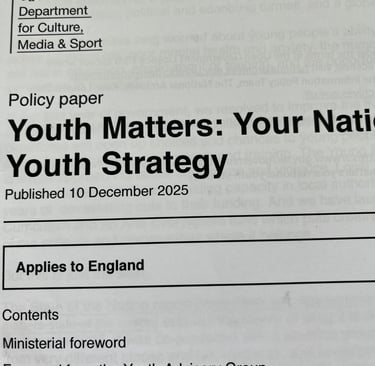
The UK government's National Youth Strategy (https://www.gov.uk/government/publications/youth-matters-your-national-youth-strategy/youth-matters-your-national-youth-strategy) has put work experience firmly on the policy map. As part of its plan to raise the bar on careers education, the strategy commits to introducing two weeks of work experience for every young person across the course of their secondary education.
The case for work experience isn't just political rhetoric. Time spent in a real workplace teaches things no classroom can fully replicate: how to communicate with adults who aren't teachers or parents, how to manage a task with a deadline, and how to navigate the small social codes of an office, shop floor, or hospital ward. For many teenagers, it's the first moment a career stops being an abstract idea on a worksheet and becomes something tangible — a person doing a job, in a place, with a routine.
It also matters for fairness. Pupils with well-connected families have always found it easier to secure a placement at a law firm or a local business through a parent's contacts. A national entitlement, delivered through schools and employers rather than left to individual initiative, aims to level that playing field.
This direction of travel is clear, and it's a welcome one. Work experience gives young people something a textbook can't: a genuine glimpse of their own future, and the confidence that comes from realising they can hold their own in it. If the government's ambition is delivered well, an entire generation could leave school not just with qualifications, but with a real sense of what work actually feels like — and that might be one of the most valuable lessons of all.
There’s a place for everything
25 April 2026
I’ve started to think differently about the clothes I own. Instead of throwing things away when they no longer suit me or leave them hanging around behind wardrobe doors, I try to see them as items with more life left in them. Recycling my clothes has become a simple but meaningful way for me to live more sustainably.
I mainly channel pieces to The Seven Day Tailor, where I’m raising funds to support projects working with young people. For items that aren’t right for the company, I list them on Vinted so they can still find a new home rather than going to waste. It’s been a creative way to extend the life of clothing while contributing to something bigger, turning items I no longer wear into opportunities that can make a difference.
When I have more casual clothes in good condition, I donate them—but I’m more mindful now. One platform I’ve found especially impactful is Give Your Best (Give Your Best). It’s an online space where people can donate clothes that anyone facing clothing poverty can browse and choose for free. I love that it gives people dignity and choice, rather than just handing down whatever is available.
If something truly can’t be worn anymore, I look for textile recycling options instead of binning it.
Recycling my clothes isn’t complicated, but it has changed how I value what I own—and that feels like a step in the right direction.
The Second Decade
14th March 2026
I hadn’t come across the term “second decade” before reading a recent article by UNICEF (https://www.unicef.org/adolescence). It’s their way of describing the years from 10 to 19 — the crucial stretch when young people begin shaping the direction of their lives.
The article looks at how UNICEF supports young people around the world to make the most of this highly formative period. It struck a chord with me, because while their work is global, my focus is much closer to home.
Through The Seven Day Tailor, I’m thinking about young people here in Cornwall.
Official statistics on the number of young people not in employment, education or training (a phrase I stubbornly refuse to abbreviate) highlight some of the challenges many face during their second decade (https://www.ons.gov.uk/employmentandlabourmarket/peoplenotinwork/unemployment/bulletins/youngpeoplenotineducationemploymentortrainingneet/february2026).
Funds generated by my company through the sale of preloved and new clothes are available to support projects in the county. I’m particularly interested in initiatives that help young people access opportunities leading to employment, education or training — though that’s not a strict rule.
If you’re involved in a project supporting young people in Cornwall, I’d love to hear from you. The funds may not be huge, but the enthusiasm certainly is.
Email me on julie@thesevendaytailor.co.uk




The Seven Day Tailor
Explore our sleek website template for seamless navigation.
Contact
Newsletter
julie@thesevendaytailor.co.uk
tel: 07487 422282
© 2024. All rights reserved.